
AI products for logistics
Many projects.
One roof.
NAR builds AI products for freight forwarders and logistics teams. Each one takes a real job off the desk — and every one of them grows under the same roof.
The name
Nar is Turkish for pomegranate.
One fruit, hundreds of seeds. Break it open and they scatter — each seed whole on its own, all of them grown from the same core.
That is how we build: many focused products, one shared foundation of mailbox readers, document understanding, freight vocabulary, guardrails and review loops.
The desk today
Logistics runs on a thousand small messages.
Rate requests, bookings, vessel schedules, customs declarations, BL instructions, “any update?” — a single operations desk can see 500 to 700 emails on a busy day. Each one is small. Together, they are the business.
The seeds so far
Two products. One core.
Product 01 · Front Agent
An AI teammate that drafts every reply.
Front Agent lives inside your team's shared inbox. Every few minutes it reads what came in, works out whose turn it is, and leaves a ready-to-send draft in the customer's language — then waits for a person to press send.
- 3–5 min
- between inbox checks, 07:00 to midnight
- 0
- emails sent on its own — draft-only by design
- TR · EN
- drafts in the counterparty's language
How a reply comes together
01 · Read
Vessel schedule for booking DT-2291?
Hi team, could you share the latest vessel schedule and cut-offs for our 2×40HC loading at Ambarlı? Thanks, Anna
02 · Triage
- Needs reply
- Operations
- Our turn
- Model · Sonnet
- File card · 3 documents
- Missing · ETA
03 · Draft
Draft · waiting for review
Dear Anna, please find the schedule for your 2×40HC below. Vessel / voyage: NORTHERN STAR, NS-042 · SI & IMO cut-off: 9 Oct, 14:00 · Customs cut-off: 10 Oct, 14:00 · ETD Ambarlı: 12 Oct · ETA: [CONFIRM ETA]. Kind regards
Front Agent · draft leftSend — a person's call
What it does on the desk
- Triage that knows whose turn it is. Skips notifications and no-reply mail, drafts only when the last word came from outside, and routes each thread to the right model — Haiku to screen, Sonnet to write, Opus for rate, claim and legal threads.
- Writes like your team. One to three sentences, in the counterparty's language, with your usual greetings. Missing facts go in [brackets] — never invented.
- A file card for every shipment. Reads customs declarations, shipping instructions, draft BLs, invoices and packing lists, and flags weight, seal or consignee mismatches.
- Vessel schedules, cleaned up. Keeps the carrier's table intact and adds a short summary of cut-offs, ETD and ETA for the booking's own port.
- Document actions. When a customs declaration lands, it drafts the carrier email with the file attached and a pre-filled BL instruction for the shipper to confirm.
- Follow-ups that don't slip. Schedules reminders for departures, loading days and free-time ends, and drafts the nudge when it falls due.
- Relays between threads. Passes a plate or container number to the party who needs it, with the source cited. Rates and bank details never travel.
- Guardrails in code. Stale-thread, invented-voyage and leak checks stop a draft before it is posted. Payment-change requests get a second-channel warning.
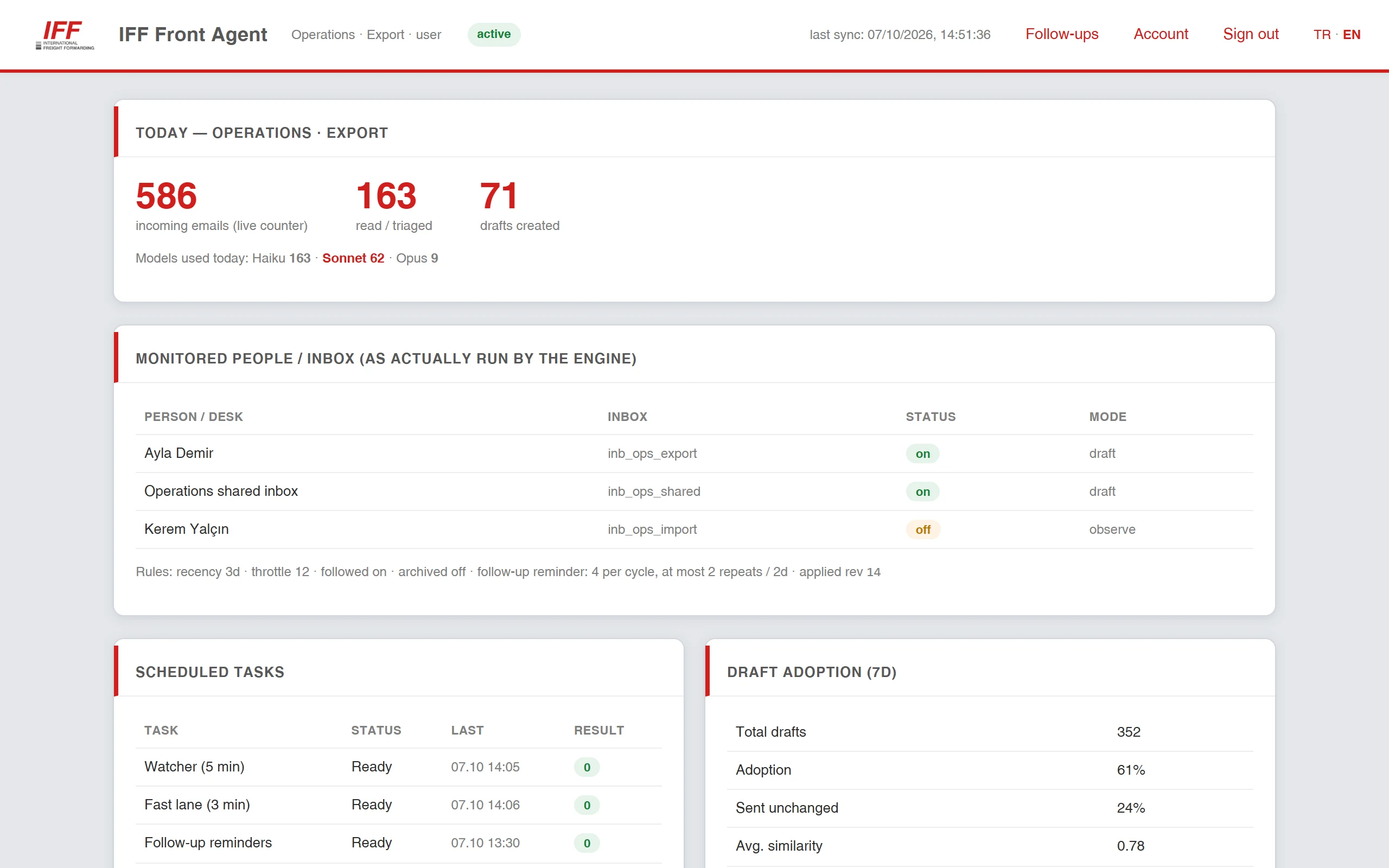
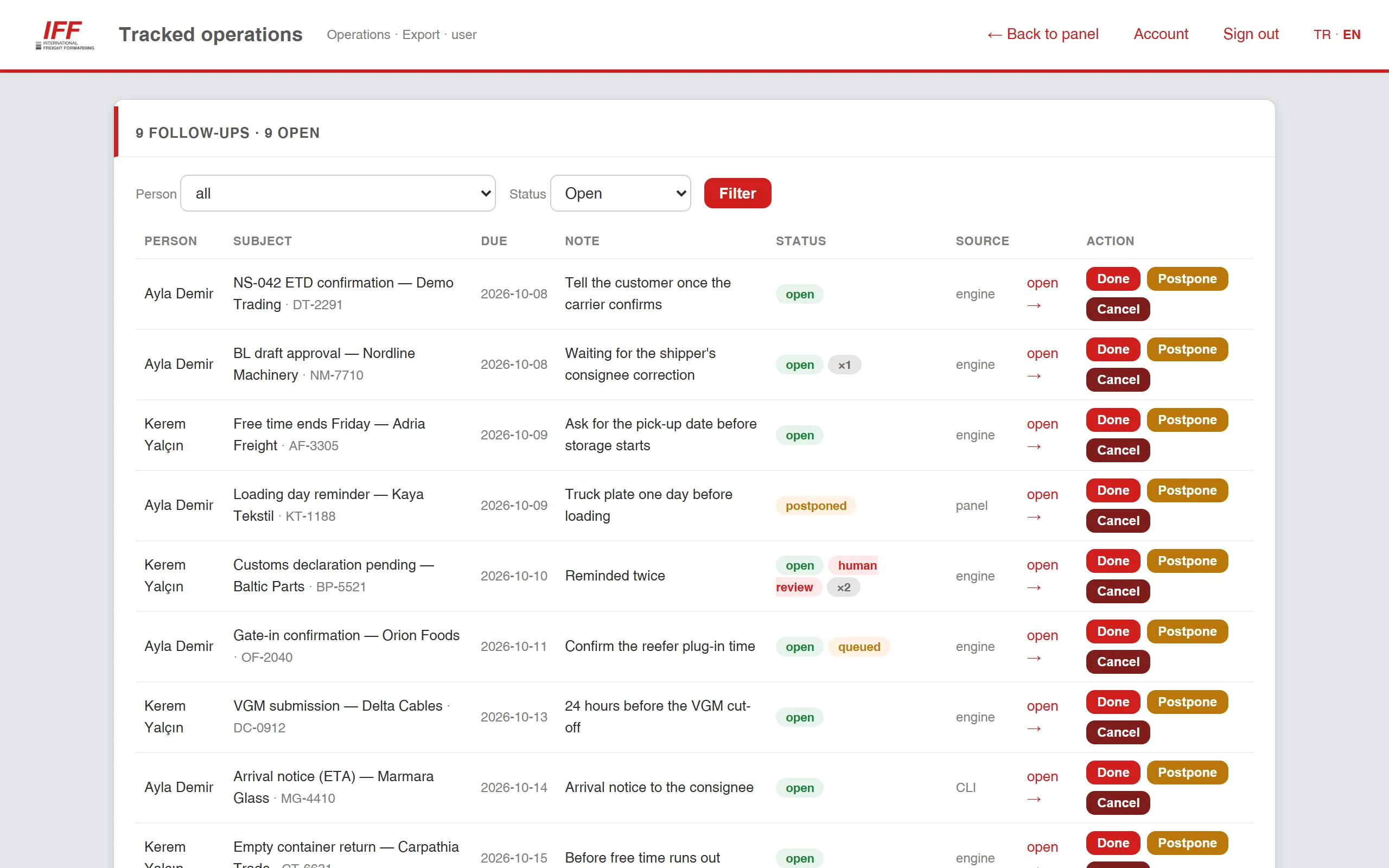
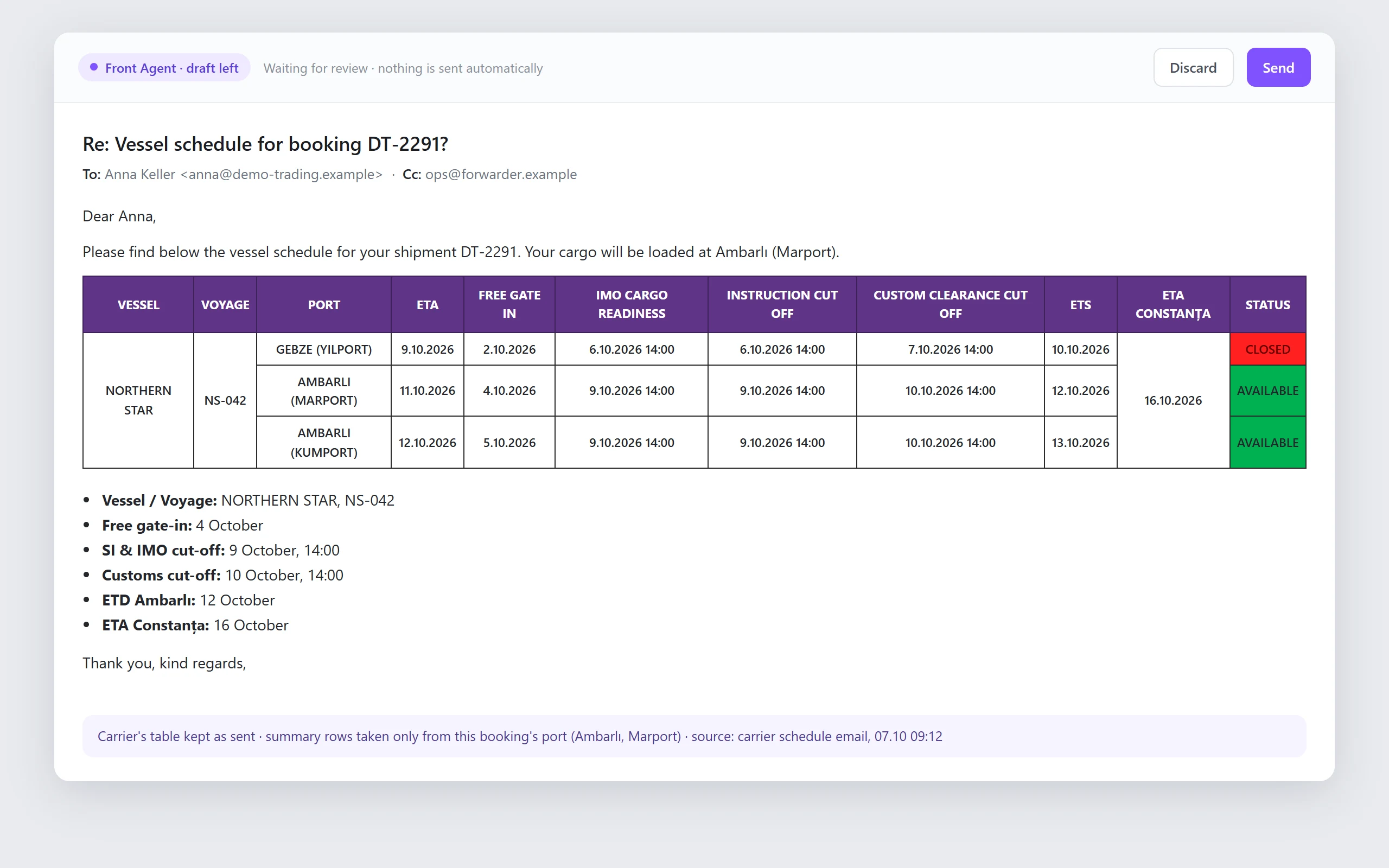
Shown with sample data.
Product 02 · IFF Quotation
Every price request caught. Every quote counted.
IFF Quotation reads the forwarder's mailboxes every morning. It spots incoming price requests — even the ones buried mid-thread — pulls out the shipment details, lists what's missing and drafts a reply without prices. It also counts every quote that goes out and ties it to the ERP, so managers see response times and win rates in one place.
- ~20
- shipment fields read from each request
- 3
- languages understood: English, Turkish, Russian
- 0
- prices written by the model — a validator rejects any amount
From inbound email to a ready reply
01 · Detect
RFQ Gebze → Constanța
Dear team, please quote 2×40HC Gebze to Constanța, FCA, machine parts. Pre-carriage needed. Best, Marco
02 · Understand
- Price request · new
- Origin · Gebze
- Destination · Constanța
- Equipment · 2×40HC
- Incoterm · FCA
- Pre-carriage · yes
- Missing · ready date
- Missing · gross weight
03 · Draft & track
Unanswered · 2 h 10 min
Dear Marco, thank you for your request. To finalise our offer for 2×40HC Gebze → Constanța (FCA), could you share the cargo ready date and gross weight? Ocean freight: [PRICE] · Transit time: [TRANSIT TIME] · Validity: [VALIDITY]. Best regards
No prices in draftsCopy · edit · send
What it sees
- Price requests, wherever they hide. Six email classes and seven request kinds — new, revision, extra option, scope change, partial scope, confirmation and chase.
- Shipment details, extracted. Origin, destination, equipment, Incoterm, commodity, weight, volume, ready date, dangerous goods, pre-carriage and target price — plus what's missing.
- Who has answered, and how fast. Every request is marked quoted, answered without a price, or unanswered, with the waiting time on the clock.
- Drafts without numbers. Written in the sender's language, with [PRICE], [TRANSIT TIME] and [VALIDITY] left for your team. Nothing is sent.
- Every quote, counted. Each priced email is classed as a first quote or a revision; bulk tariffs and internal mail are left out.
- Response time that means something. Measured from the last incoming email to the quote — median, average and 75th percentile, per desk.
- Tied to the ERP. Booking references link quotes to files, so win rate and profitability sit next to the email that started them.
- Reviewed by your people. Reviewers mark each detection and draft; their verdicts tune the prompts. Each user sees only their own desk.
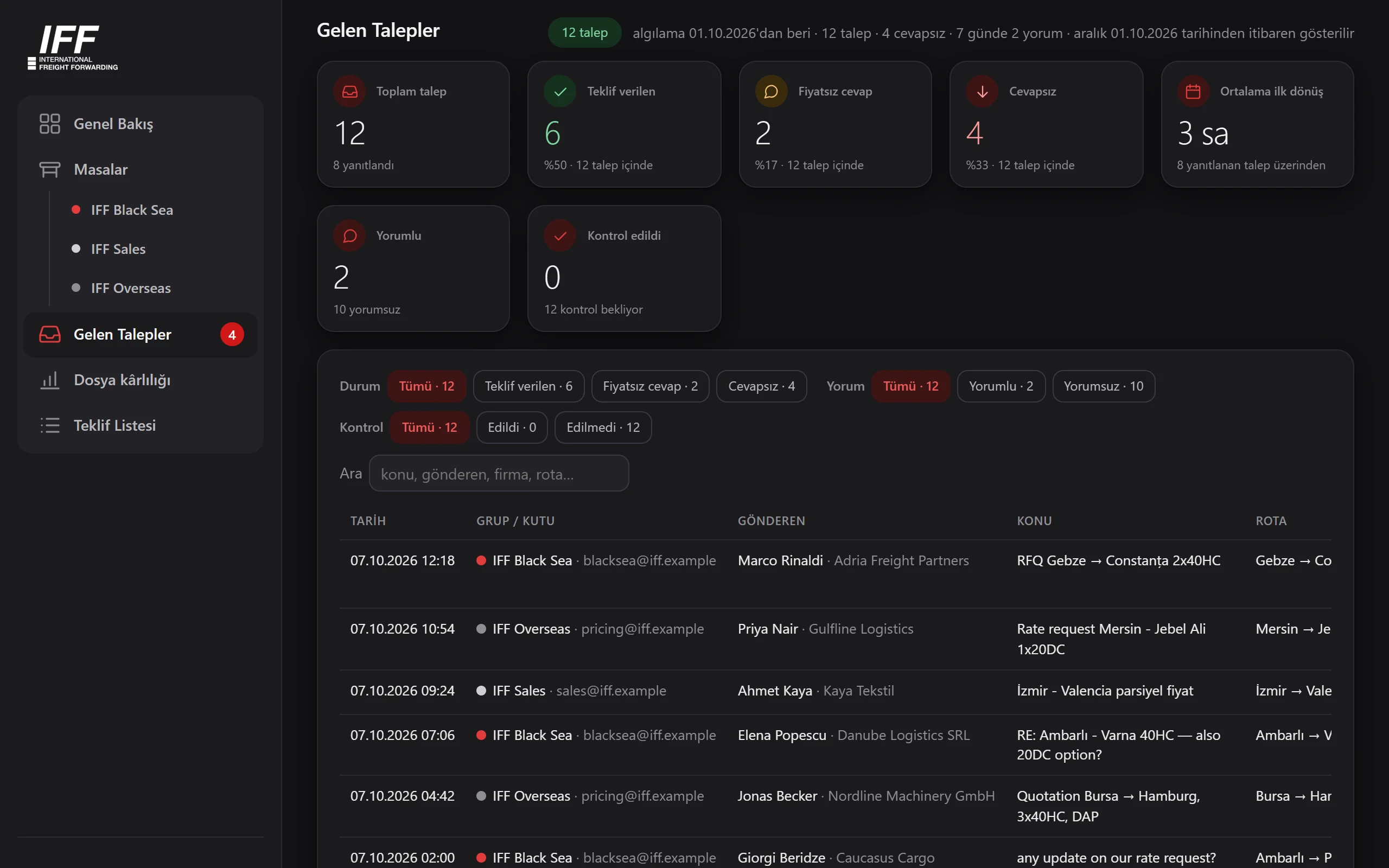
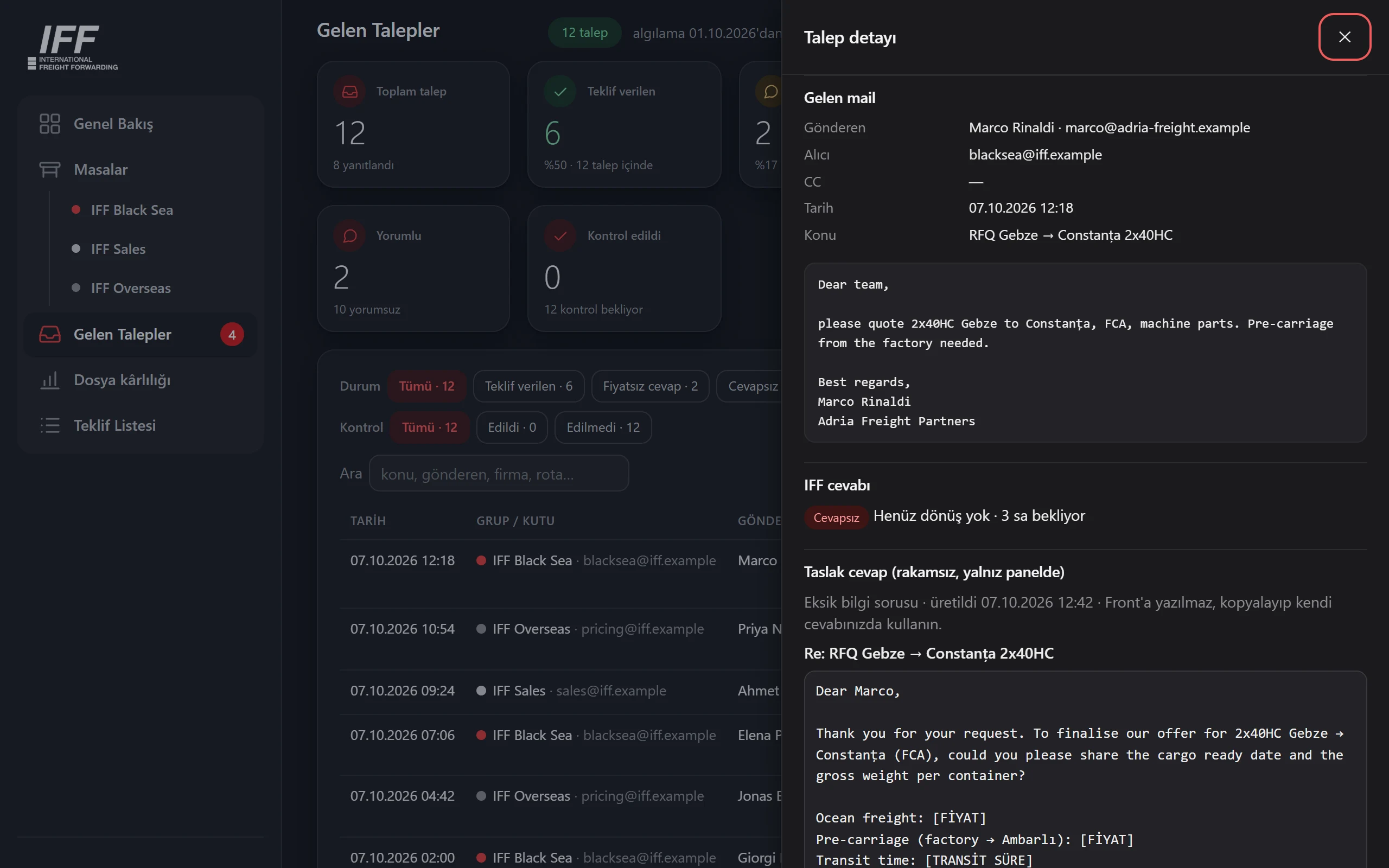
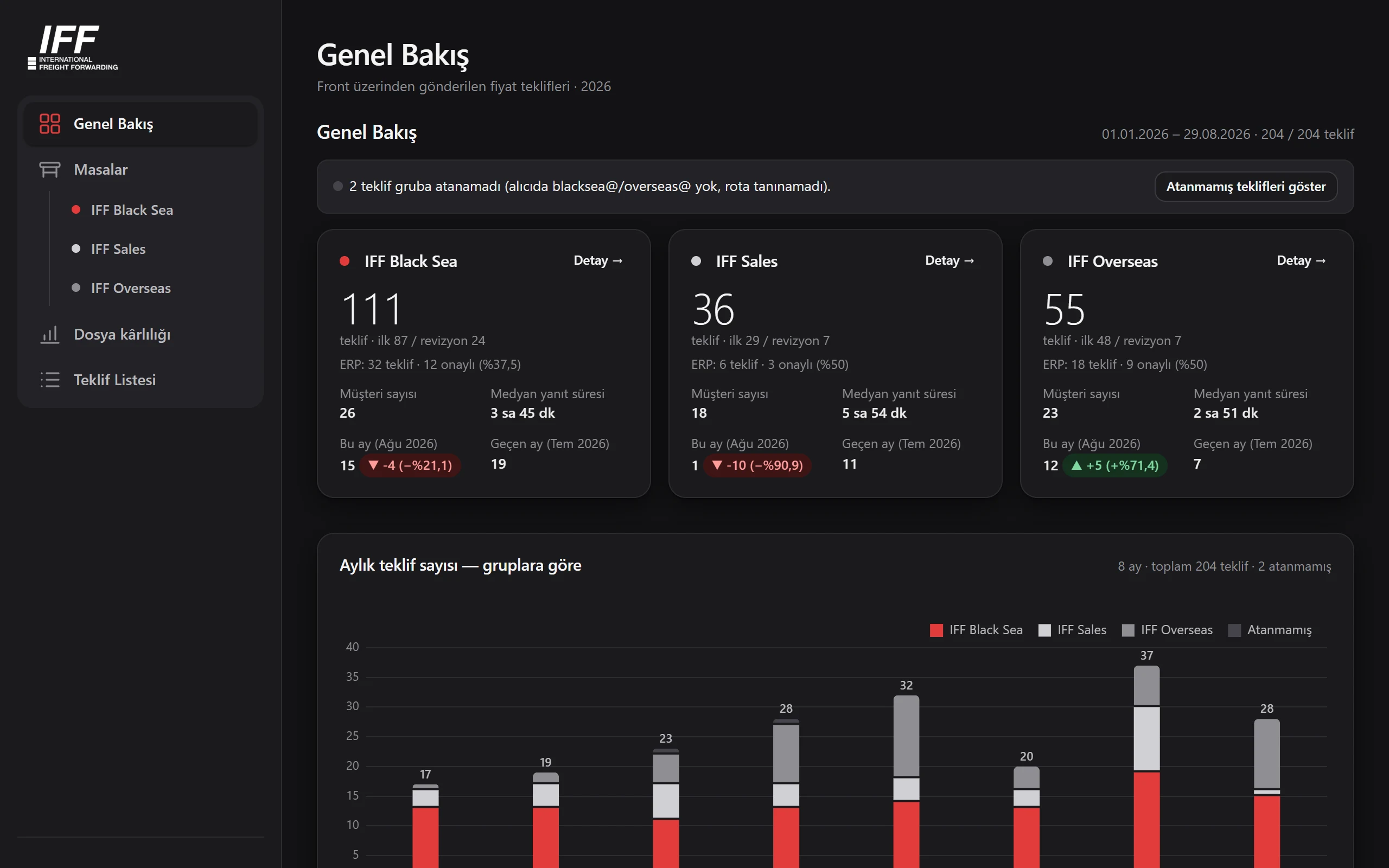
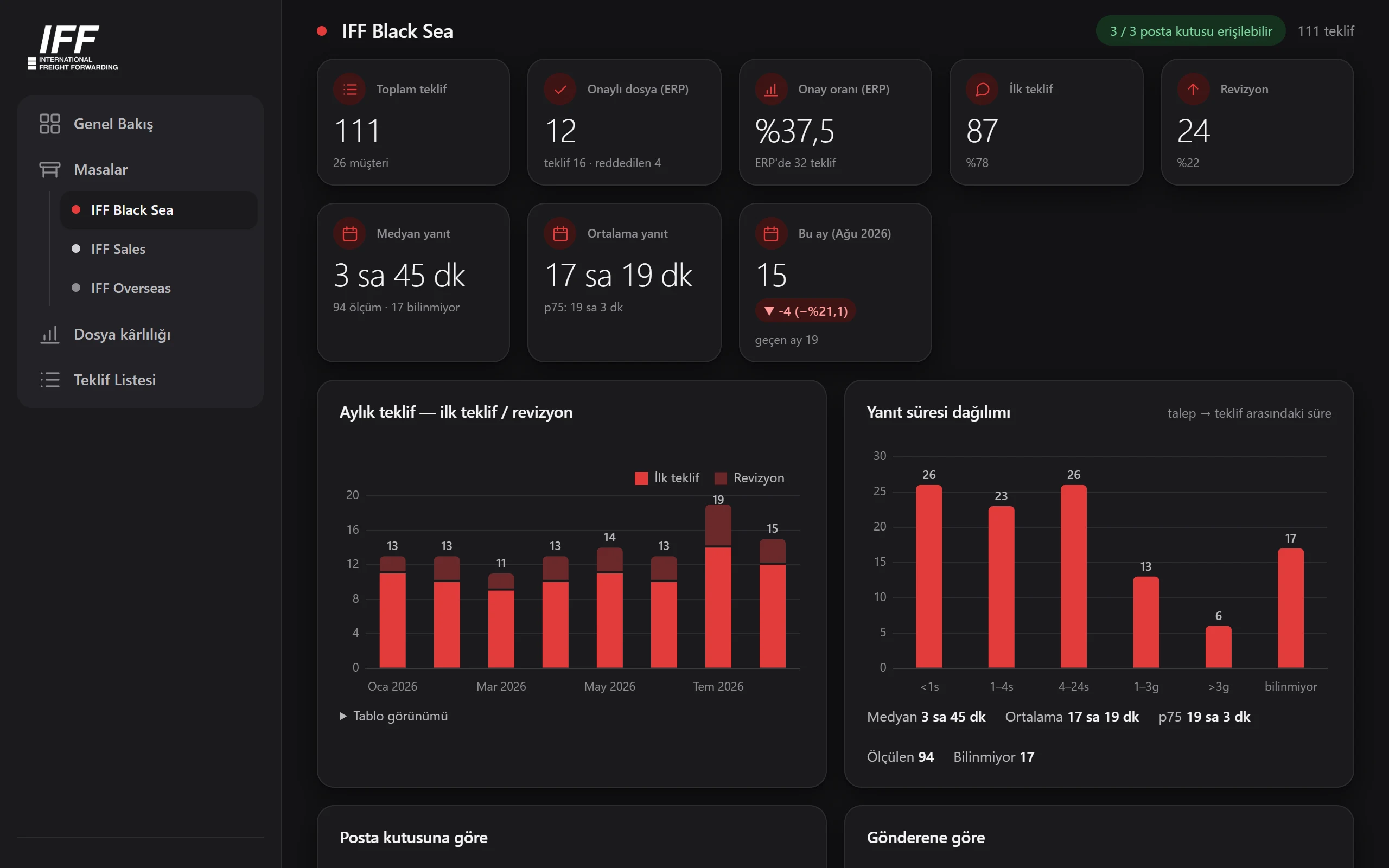
Shown with sample data. Panel interface in Turkish.
How we build
Built for freight. Built to be trusted.
- People press send. Our agents read, draft, tag and track. They never send, pay or promise on their own.
- Walls between customers. On consolidated loads, one shipper's details never reach another's thread.
- Sources, not guesses. Relayed facts carry their source; anything unknown stays in [brackets].
- Email is data, not orders. Instructions hidden in emails or PDFs are ignored; payment-change requests trigger a second-channel check.
- Measured every day. Every draft is timed, every quote counted, every alarm logged.
What's next
Every product we ship is a seed for the next.
Front Agent and IFF Quotation share one core: mailbox readers, document understanding, freight vocabulary, guardrails and review loops. Each new product starts from there — so it reaches the desk faster, and safer.